For manufacturers
When a work order has outgrown the task board
Plenty of small manufacturers run production out of a general task tool. It works until the day somebody ships a job that never passed QA, or invoices one that was never signed off, and nobody can say who moved the card.
Departments in order
Enquiry, quote, build, QA, despatch, invoice. A job passes through in sequence or not at all.
Sign-offs that are real
Name the person and attach the sheet, or the job does not reach despatch.
Beside your stock system
No inventory and no BOMs here on purpose. It runs the job alongside whatever holds them.
Built from your spreadsheet
Upload the sheet you run on now and the process is proposed back to you, ready to edit.
What breaks when work orders live on a task board
A task board models a list of things to do. A work order is not a list of things to do. It is one object that has to pass through departments in a fixed order, collecting information as it goes, and it has a state that matters to money at the end.
So people bolt on conventions. A column per department. A checklist in the description. A naming convention in the title. A rule that you do not move the card until the drawing is attached. All of these are honour systems, and none of them survive a busy week.
The specific failures are always the same three. A job moves to the next department without the information that department needs, so somebody walks back to ask. A job gets marked done when it is not, because marking it done is a drag. And nobody can reconstruct afterwards what actually happened, because a card carries no history worth reading.
Runs the job, alongside your stock system
Streams has no inventory, no BOM and no stock levels, and it is not trying to have them. It runs alongside whatever system holds those.
What it replaces is the other half: the running of the job itself, from enquiry to quote to build to QA to despatch to invoice. It refuses to let a job skip a stage, keeps the evidence on the job rather than in somebody's email, and pushes the invoice into your Xero or QuickBooks.
The job stops being a card somebody drags.
Gates where the money and the quality are
Say what each stage needs before a job leaves it. A signed drawing before it goes to the floor. A QA sheet and an inspector's name before despatch. A serial number before it is invoiced. The job stays where it is until those fields have values, and the person is told which ones are missing.
You can gate on actions too, not just fields. A job cannot leave the quoting stage until the quote has actually been sent, or until the customer has actually accepted it, whichever you pick. A job cannot be closed until an invoice has been raised, or until it has been paid in full. Only genuine work counts: a cancelled quote or a voided invoice does not satisfy the gate.
Bring the spreadsheet you already run on
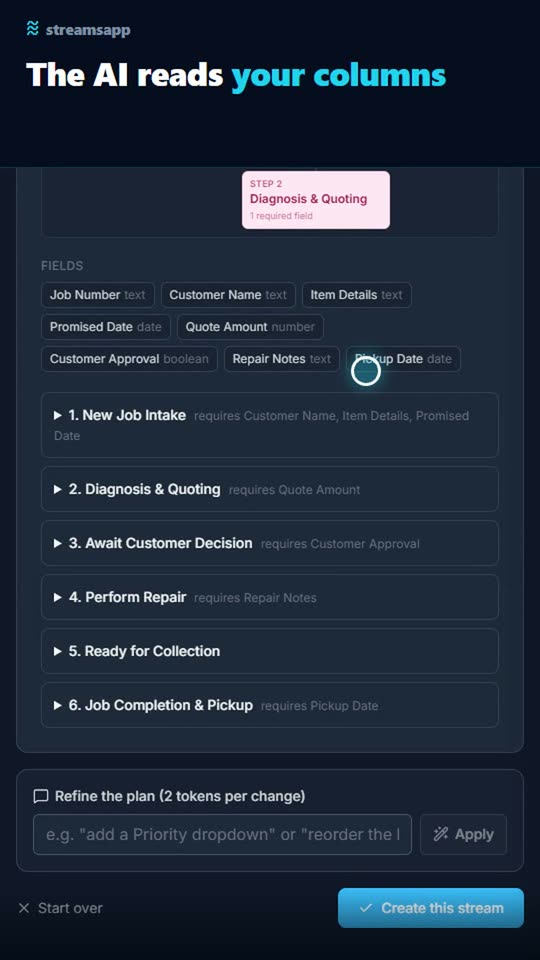
Most production processes are already written down, in a spreadsheet with a status column and twenty other columns of detail. Upload it. The columns become fields with sensible types, the status column becomes the stages, and you review the whole proposed process before anything is created.
It also reads an SOP, a Word procedure or a slide deck, if that is where your process actually lives. You edit whatever it got wrong, and you are running in an afternoon rather than a month.
See it happen
Drop the spreadsheet you already run on into Streams. The AI reads your columns, works out the process behind them and builds it. Then bring the rows across and hand each job to whoever is doing it.
A starting point: the Production Orders template
Track each production order through the workshop, with a QA inspection that must be recorded before anything is dispatched. 4 stages and 18 fields, with written instructions on every stage. Change any of it, because it is your process.
Questions
- Does this replace an ERP or MRP system?
- No. There is no inventory, no bill of materials and no stock level in Streams, and none is planned. Streams runs the job itself and handles the quote, the gates and the invoice.
- Can it stop a job being invoiced before QA has signed off?
- Yes. Make the QA sheet and the inspector's name required fields on the QA stage, and a job cannot reach invoicing without them. You can also require that an invoice has actually been raised before the job is allowed to close.
- We track work orders in a general project tool today. Is moving hard?
- Export what you have to CSV and import it, or upload the spreadsheet or procedure your process is written in and have the stages and fields proposed for you. The free plan is enough to put a real work order through end to end before you commit to anything.
- Can different people see different stages?
- Yes. Each stage can be set so team members can work on it, can see it but not change it, or cannot see it at all. That is how costing stages stay hidden from the floor while the floor still owns the stages it should.
Weighing it up against
Other trades doing the same thing
Start with the free plan
Two users, 500 records and every feature switched on. No credit card, and your data stays in Australia.
Get started free