For safety inspections
The inspection can't be signed off until the hazard is fixed
A paper checklist is good at finding hazards. It is no good at making sure they are fixed. The missing edge protection gets written down, the sheet goes back in the ute, and the site moves on with nobody able to say whether it was ever dealt with.
Hazards closed, not noted
A corrective action and who did it are required before an inspection can be signed off.
The same checks everywhere
One set of stages and instructions, used on every site by every inspector.
A history the auditor can read
Every change logged with who, when and the before and after values. Exports to CSV.
Open hazards surface
Target days per stage, flagged on the record and emailed to whoever owns it.
The same inspection on every site
Write the inspection down once: scheduled, inspected, hazards actioned, signed off. Every site is then inspected through the same stages, asking for the same information, whoever is doing the walk.
Each stage carries its own written instructions, sitting on the step where the work happens. A new inspector reads what to check and what to record at the stage they are on, rather than in a procedure in a folder.
Add a user field and the inspector can be picked from your team rather than typed three different ways, and the risk rating chosen from a fixed list rather than whatever somebody wrote that day.
A hazard is not closed until something was done about it
Make the corrective action and the person who actioned it required on the hazards stage. An inspection cannot move to sign-off until they have values. Try, and it stays where it is, with the missing field named.
That turns 'we noted it' into 'we fixed it', because the only way to reach sign-off is to write down what was done and who did it.
Where one inspection finds several hazards and the next finds none, mark a hazards stream as a sub-stream of your inspections. Each hazard becomes its own record raised against the inspection, with its own stages and its own required corrective action.
Evidence where the auditor will look
Attach the photographs, the scaffold tag or the test certificate to the inspection itself. Photograph a document and its text is read off it and kept on the record, scanned on our own service in Sydney.
Every field edit and stage move is in the audit log with who made it, when, and the before and after values. It exports to CSV when somebody asks to see the history.
Inspections that do not slip
Give each stage a target number of days. An inspection with hazards still open past the target is flagged, listed in the weekly summary, and emails whoever owns it the morning after it goes over.
The analytics view shows how many inspections sit at each stage and how long they wait there on average, across every site at once.
See it happen
Was that hazard ever fixed? Safety inspections on paper find the problems, but nothing makes sure each one is closed out before the site moves on. Here is how Ochre Flats Constructions runs site safety inspections as a stream: Scheduled → Inspected → Hazards actioned → Signed off, and nothing moves on until each step is done.
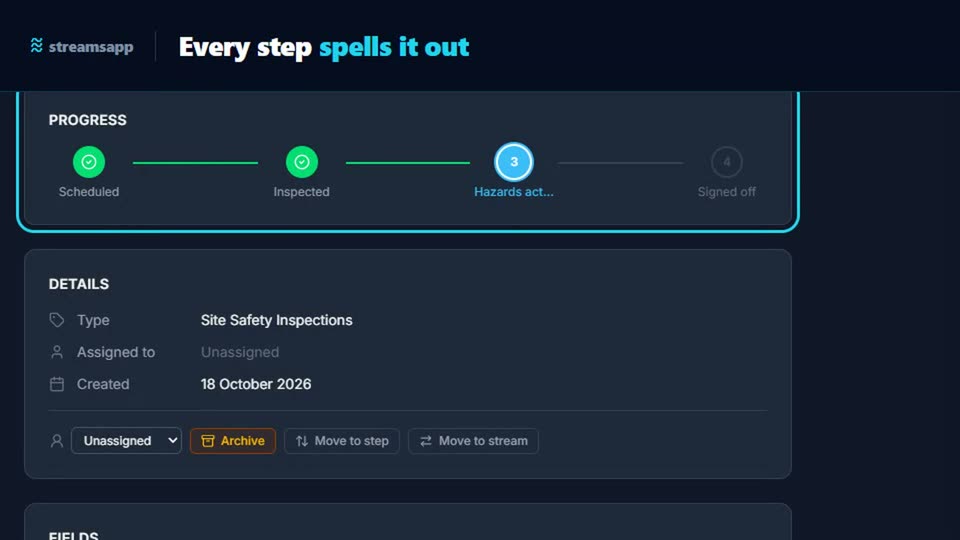
A starting point: the Site Safety Inspections template
Run site safety inspections the same way every time: scheduled, inspected, every hazard actioned, then signed off. 4 stages and 14 fields, with written instructions on every stage. Change any of it, because it is your process.
Questions
- Can an inspection be blocked until every hazard has a corrective action?
- Yes. Make the corrective action a required field on the hazards stage. The inspection will not reach sign-off until it has a value, and the person moving it is told which fields are outstanding.
- Can one inspection record several hazards?
- Yes. Mark a hazards stream as a sub-stream of your inspections stream. Each hazard is then raised against a particular inspection as a full record with its own stages, and the inspection lists everything raised against it.
- Does using this make us compliant with safety law?
- No software does that on its own. Streams makes sure your own inspection process is followed the same way every time and keeps a record of who did what and when. What the process should contain is still your call, and your safety adviser's.
- Does it work on a phone on site?
- Yes. It runs in the browser on a phone, so there is nothing to install. The inspector opens the inspection, sees the stage they are on and what it needs, and fills it in.
Other trades doing the same thing
Start with the free plan
Two users, 500 records and every feature switched on. No credit card, and your data stays in Australia.
Get started free