For maintenance requests
Every request reported, booked and signed off
Maintenance requests arrive by text, by email and in the corridor. Somebody says they will sort it. A week later nobody can say whether the cool room was looked at, who was called, or whether it was fixed twice.
Sites see only their own
One login per site, each submitting its own requests. Facilities sees every site at once.
No booking, no progress
The contractor and the cost are required before a request can be scheduled.
Late jobs surface themselves
Target days per stage, a weekly summary, and an email the morning a request runs over.
Proof it was done
A named sign-off on completion, photos on the request, and every change in the audit log.
One place to report it
Write the process down once: reported, assessed, scheduled, completed. Every request goes in at the top with the site, the issue and the priority, and from then on it has a stage, an owner and a history instead of a thread.
Give each site or store its own login and turn on 'members see only their own records'. Each site submits its own requests and sees only those, while the facilities team sees every site at once. A field can fill itself with the name of whoever logged the request, so 'reported by' is never left blank.
If you already have a request form on your website, it can post straight into the stream through the inbound API, so nobody retypes it.
Not 'someone is on it'. A named contractor
Make the contractor and the quoted cost required on the assessment stage. A request cannot be marked as scheduled until somebody has actually written down who is coming. When they try, they are told which field is missing, and the request stays where it is.
That is the gap most maintenance goes missing in: assessed, agreed it needs doing, and then never booked. A stage that will not let go of the request until the booking exists closes it.
Require a sign-off name on the completed stage as well, and 'done' starts meaning somebody checked it.
Nothing quietly forgotten
Give each stage a target number of days. A request sitting past its target is flagged on the record, appears in the weekly summary to owners and admins, and emails whoever it is assigned to the morning after it goes over.
Put an email on a stage and it sends itself when a request arrives there. Head office can be told the moment a request is logged, with the site and the issue filled into the message.
Photograph the fault, the contractor's docket or the compliance certificate and keep it on the request. Scanned text is read on our own service in Sydney, so the document does not leave the country.
See where the money and the backlog are
The stream's dashboard counts requests at each stage and can total the quoted cost. The analytics view shows how long requests sit at each stage across every site, and which ones have been stuck the longest.
Every change is in the audit log with who made it and when, so 'was that ever fixed' has an answer that does not depend on anyone's memory.
See it happen
Who's fixing the cool room? Maintenance requests arrive by text, email and corridor conversation, and nobody can say which ones are actually being handled. Here is how Gantry Hill Facilities runs maintenance requests as a stream: Reported → Assessed → Scheduled → Completed, and nothing moves on until each step is done.
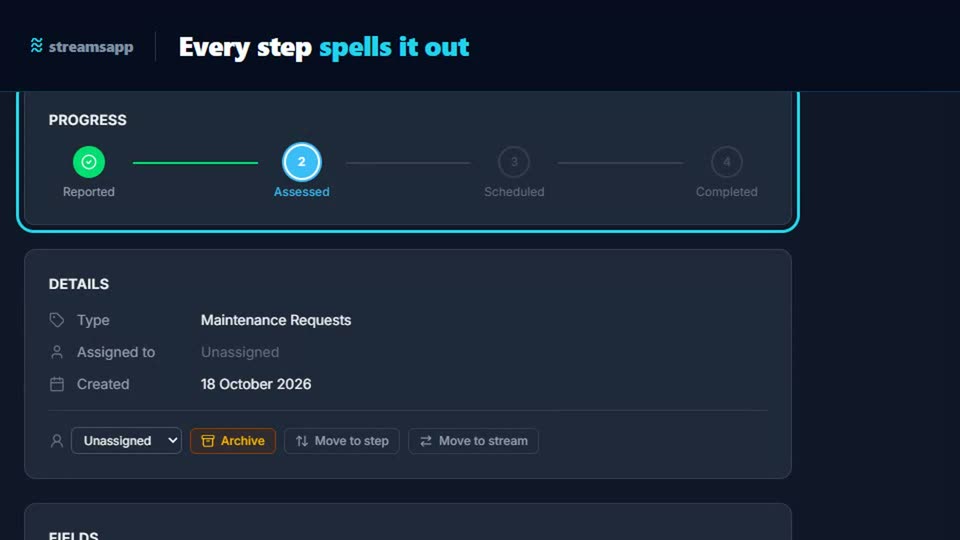
A starting point: the Maintenance Requests template
Track maintenance requests from every site through assessment, contractor booking, attendance and sign-off. 4 stages and 14 fields, with written instructions on every stage. Change any of it, because it is your process.
Questions
- Can each store report its own maintenance without seeing other stores?
- Yes. Give each store a login and turn on 'members see only their own records' for the stream. A store sees only the requests it created, in lists, search, counts and analytics, and a direct link to another store's request does not open. Admins see every store.
- Can I stop a request being scheduled before a contractor is booked?
- Yes. Make the contractor field required on the assessment stage. The request will not move on until it has a value, and the person moving it is told exactly which field is missing.
- Can head office be emailed when a new request comes in?
- Yes. Put an automation on the stage the request arrives at and a templated email sends itself, with the site and the issue filled in. It fires every time a request enters that stage.
- Is this a full asset management system?
- No. There is no asset register, parts inventory or planned maintenance schedule built in. It runs the request itself, from report to sign-off, and makes sure nothing in between is skipped.
Weighing it up against
Other trades doing the same thing
Start with the free plan
Two users, 500 records and every feature switched on. No credit card, and your data stays in Australia.
Get started free